Showing posts with label Urinary cortisol:creatinine ratio. Show all posts

Saturday, February 26, 2011

Diagnosing Canine Cushing's Disease: Should the ACTH Stimulation Test Ever Be Used?

How does this test work? What are we really evaluating with the ACTH stimulation test?

First of all, the basis for this test is that dogs with pituitary-dependent hyperadrenocorticism (PDH) or functional, cortisol-secreting adrenal tumors (FAT), because of their increased adrenocortical mass or volume, have the capacity to secrete excessive amounts of cortisol.

This is an indirect test that gauges the degree of adrenocortical thickness. Unlike the low-dose dexamethasone suppression test, the ACTH stimulation test doesn’t look at the entire hypothalamic-pituitary-adrenal (HPA) axis or the effect of glucocorticoid-negative feedback on the HPA axis.
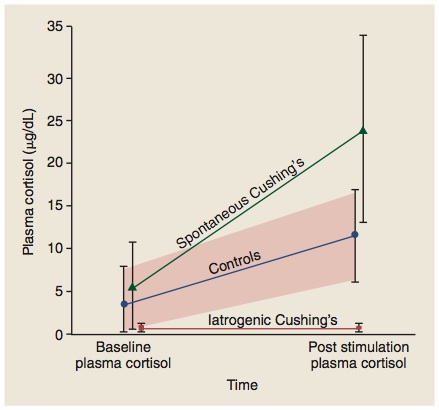
In normal dogs, administration of ACTH produces a rise in serum cortisol to values usually >10 μg/dl (>300 nmol/L). In contrast, dogs with Cushing’s syndrome (because of the increased thickness of the adrenal cortex) tend to have an exaggerated cortisol response to ACTH administration, with post-ACTH serum cortisol rising to concentrations >20 μg/dl (>600 nmol/L). Dogs with iatrogenic Cushing's have a blunted cortisol response to ACTH (see figure).

But what’s the percentage of dogs with Cushing’s disease that are actually diagnosed with this test? What’s the test sensitivity?

About half of dogs with cortisol-secreting adrenocortical tumors and about 80% of dogs with pituitary-dependent hyperadrenocorticism (PDH) show an exaggerated cortisol response to the ACTH stimulation test.

In clinical practice and reality, however, the sensitivity is actually worse than those statistics reveal. Although it is clear that over 20% of dogs with Cushing's syndrome have post-ACTH cortisol test results within the reference range (< 20 μg/dl for my laboratory), an additional 20-30% of dogs with Cushing's have test results described as "borderline" (serum cortisol concentrations >16 μg/dl but <24 μg/dl).

In effect, that means that only 50-60% of dogs with Cushing's disease will have serum cortisol responses that are clearly abnormal (> 25 μg/dl). In other word, this test is a poorly sensitive diagnostic test for Cushing’s syndrome. In most dogs, it would be more cost effective to turn to another test, such as the low-dose dexamethasone suppression test, as the first-line screening test.

Other disadvantages to using the ACTH stimulation test:

In addition to the ACTH stimulation test’s mediocre test sensitivity, there are 2 other reasons for choosing one of the other diagnostic tests over the ACTH stimulation test, including the following.
  1. First, of all, the cost of the preferred ACTH (cosyntropin; Cortrosyn) is high. I’ll discuss more about why you need to use cosyntropin in my next post (I’ll also offer my suggestions on how to extend the shelf-live of Cortrosyn to make it more cost effective).
  2. Secondly, this test cannot determine the underlying cause of Cushing's syndrome. In other words, a positive ACTH stimulation test doesn't tell you whether the dog has PDH or FAT, so additional testing will always be needed to determine that. It is a true screening test, and no features of the ACTH stimulation test result allow discrimination between PDH and FAT.
Are there any clinical situations where we should use the ACTH stimulation test?

Yes, there are definitely 3 situations in which ACTH stimulation testing would be indicated as a diagnostic or monitoring test for adrenal disease in dogs. The major indications for using the ACTH stimulation include the following:
  1. Best test to diagnose iatrogenic hyperadrenocorticism in dogs. If the dog has clinical and laboratory features consistent with Cushing’s syndrome (e.g., polyuria, polydipsia, polyphagia, pot-belly, truncal hair loss, high serum alkaline phosphatase) but has a recent history of glucocorticoid use, this is the test of choice. If the cortisol response to ACTH stimulation is low-normal or blunted in this dog, the diagnosis would be iatrogenic Cushing’s, rather than the naturally occurring disease. None of the other pituitary-adrenal function tests can make this differentiation.
  2. Best test to use for monitoring and adjusting mitotane or trilostane therapy. Again, this is the only pituitary-adrenal function test that can be used in this situation; none of the other pituitary-adrenal function are useful in monitoring drug treatment.
  3. “Gold Standard” test to diagnose spontaneous hypoadrenocorticism (Addison’s disease). This is true whether the dog has primary or secondary hypoadrenocorticism or typical or atypical disease; the ACTH stimulation test is the only test to use for this diagnosis. As you can see in the figure below (an Ad from the company that manufactures Cortrosyn), the main indication for ACTH as a diagnostic test is adrenocortical insufficiency, not Cushing's syndrome.
In general, there is a general rule for endocrine disease that is useful to remember when approaching endocrine hyperfunction vs. hypofunction:

In almost all cases, it is better to use stimulation tests to diagnose endocrine hypofunction, whereas suppression tests are best used for endocrine hyperfunction.

So with the ACTH stimulation, the 3 situations (listed above) where this test really has advantages over the other screening tests all include situations where the adrenal glands have been suppressed (iatrogenic steroid use, trilostane, mitotane) or destroyed (Addision’s disease)!

Wednesday, February 16, 2011

Q & A: Cushing's in dogs...If it looks like a duck and quacks like a...

I saw a 4-year-old, MC Maltese today for a second opinion consult. The dog has severe polyuria and polydispia (PU/PD), and has also developed progressive lethargy, weight gain, extreme panting, and polyphagia over the last few months. The dog also has a marked pot bellied appearance, and has an large liver on abdominal palpation.

Results of my screening lab work is unremarkable except for a high serum alkaline phosphatase (805 U/L; normal < 100 U/L).  The urine specific gravity is dilute at 1.005.

Results of abdominal ultrasound show an enlarged liver with a diffuse increase in echogenicity. The left adrenal gland is mildly plump at 0.6 cm in diameter and 1.45 cm in length. The right adrenal gland was normal in size.


I did a low-dose dexamethasone suppression test with these results:  Pre 8.6 μg/dl;  4-hr Post 0.4 μg/dl; and 8-hr Post 1.4 μg/dl. The owner was told by other veterinarians that these results were not diagnostic for Cushing's syndrome, I guess, because of the 8 hr Post of 1.4 μg/dl.


This dog definitely looks Cushingoid. Clients refused to do a University of Tennessee adrenal panel or a urine creatinine ratio because of finances.  I am very inclined to treat with trilostane.   What do you think?

My Response:

This dog certainly sounds like he has Cushing's syndrome to me, too.  The results of the low-dose dexamethasone suppression test are very suggestive of pituitary-dependent Cushing's disease, with complete suppression at 4 hours and some escape at the 8-hour test period. I understand that the laboratory may have a diagnostic "cut off" value that is slightly higher than 1.4 μg/dl, but this test is very suggestive given the dog's signalment and clinical features.


I do agree with the owner that the University of Tennessee panel is expensive and is probably a waste of money for this dog. Everything so far is pointing to "typical" Cushing's disease so we need to use the time-honored tests for Cushing's first. In many dogs, we have to do more than one of the screening tests (sometimes more than once over to time) to confirm this disease, and you have only done one screening test on one occasion. So which should you do next, the ACTH stimulation test or measure urinary cortisol:creatine ratios (UCCRs)?


I would not bother with an ACTH stimulation test because it has the lowest test sensitivity (only 60-80%). This is another reason not to do the University of Tennessee adrenal panel. In addition, the ACTH that must be injected is expensive.


I would have the owner collect 3 urine samples at home and bring them to your hospital for submission for UCCRs. If money is an issue, you can take a small aliquot (1.0 ml) from each of the 3-day's urine samples the owner collected, and submit the pooled urine for a single UCCR result. This will then give you a 3-day average of urine cortisol secretion. If this is positive, then I'd treat with either trilostane or mitotane.


What if the owner refuses to do more tests? Then I certainly wouldn't start treatment at all. If the owner does not have the money to do a single UCCR, then how can they afford the medication or monitoring costs??  Cushing's is a very serious disease and, unfortunately, we do not have an inexpensive means of treating this disease.


It's time to have a heart to heart talk with the owner about this disease and what they really can afford.

Tuesday, February 1, 2011

Diagnosing Cushing's Syndrome in Dogs: When Should I Test? What's the Best Test to Use?

How do we best diagnose hyperadrenocorticism in dogs? Which is the best diagnostic test?  A presumptive diagnosis of should be made from clinical signs, physical examination, routine laboratory tests, and diagnostic imaging findings, but the diagnosis must be confirmed by use of cortisol hormone assays and pituitary-adrenal function tests. For screening tests designed to diagnose Cushing's syndrome, we have three choices:
  • ACTH stimulation test
  • Low-dose dexamethasone suppression test (LDDST)
  • Urinary cortisol:creatinine ratio (UCCR)
Which screening test is best?

Unfortunately, none of the diagnostic tests used in dogs with suspected Cushing's syndrome are totally reliable, and both false-positive and false-negative results are common. Because there are inherent problems with these diagnostic tests, the veterinarian is frequently challenged when attempting to properly interpret the dog’s tests results.

It is important to remember, however, that the predictive value of a positive screening test result for Cushing's increases in direct proportion to the number and severity of clinical signs and biochemical changes that develop in this disease. Therefore, one must always remember the importance of the dog’s signalment, history, and physical examination findings when interpreting the diagnostic test results of all pituitary-adrenal function tests.

Who should be tested for hyperadrenocorticism?

Testing for hyperadrenocorticism in a dog should be done because they have one or more clinical signs of the disease. Typically the disease is insidious and slowly-progressive, so most dogs have had clinical signs, such as abdominal enlargement, panting, muscle weakness, thin skin, lethargy, polyphagia, polyuria and polydipsia (PU/PD) for months to even years before the owners recognize a problem and seek veterinary help.

Who should NOT be tested for hyperadrenocorticism?

Testing for Cushing's syndrome is not recommended if the only abnormality is an increased serum alkaline phosphatase (SAP) activity on a serum chemistry panel, and the dog is otherwise apparently healthy. It is difficult enough to interpret endocrine tests in dogs with clinical signs of the disease; if they have no clinical signs, all of the endocrine tests may be difficult to interpret because of false-positive and false-negative results. The first step in workup in these dogs may include an abdominal ultrasound or bile acid testing.

One should not screen dogs for hyperadrenocorticism when the dog is sick with clinical signs that would not be related to Cushing's syndrome (e.g., vomiting, anorexia, weight loss). Many non-specific illnesses and other systemic diseases will produce false-positive results with the endocrine tests. Remember, hyperadrenocorticism is only slowly progressive, so hyperadrenocorticism is never an emergency diagnosis.

Before diagnostic testing is performed, it is therefore always good to ask oneself: if the test results would indicate hyperadrenocorticism, would I then feel confident to start treating with mitotane (Lysodren®) or trilostane (Vetoryl®) given the clinical picture of the patient? Would treatment help the dog's clinically signs? If either answer is "no," then it is probably best not to screen for hyperadrenocorticism in the first place.

My dog has clinical signs of hyperadrenocorticism and now other nonrelated illness − now can I test?

If the dog has any or all of the clinical signs of hyperadrenocorticism, yes, you should proceed with testing of the pituitary-adrenal axis. However, it is necessary first to ensure that the dog is not being exposed to exogenous glucocorticoids, including topical glucocorticoids on the eyes, ears or skin. First check with the owner to ensure that they are not applying topical glucocorticoids to their own skin − sometimes, dogs may ingest glucocorticoids by licking steroid-containing cream off of the owner's skin. If there is any doubt, ask the owner to bring in all and any medications that dog is receiving (including over the counter preparations) and anything that the owner or owner's family might be using in order to verify that no glucocorticoids are in any of these medications.

Next, obtain a routine database (CBC, serum chemistry analysis, and complete urinalysis) before any endocrine testing is undertaken. Finding the expected clinical pathology changes in a dog with suspected Cushing's syndrome helps confirm what the initial history and physical exam suggested. Typical abnormalities in dogs with hyperadrenocorticism include high values for serum alkaline phosphatase, alanine aminotransferase, low to low-normal serum urea nitrogen, and dilute urine specific gravity.  On the CBC, we may see a  'stress' leukogram (elevated mature neutrophils and monocytes, decreased lymphocytes and eosinophils), and a hematocrit and RBC count at the high end of normal.

What about now? Now should I use one of the screening tests?

If all the analyses point to hyperadrenocorticism at this stage, test away! In an upcoming blog, I'll be discussing the pros and cons of the ACTH stimulation test for Cushing's syndrome.